Freelancing
Upwork vs Fiverr vs Direct Clients in 2026: Fees, Pros and Cons and What You Actually Keep
Compare Upwork, Fiverr and direct clients for freelancers in 2026: fees, how you get work, payment protection, pros and cons, and which to choose by stage.
By Md Mahfuj HossainPublished 4 min read

Quick answer: On fees, Upwork charges freelancers a service fee of 0% to 15% depending on factors such as supply and demand (up to 5% on direct contracts), with an optional $19.99 monthly plan; Fiverr takes a flat 20% commission. On a $1,000 job, that is roughly $850 to $1,000 kept on Upwork and $800 on Fiverr; direct clients keep the most but require you to find them. A common path is to start on a platform for proof and payment protection, then move repeat clients to direct work.
Key takeaways
- Fees differ in kind: Upwork variable, Fiverr flat.
- Upwork is proposal-based; Fiverr is gig-based where buyers find you.
- Direct clients keep 100% but need outreach and contracts.
- Check each platform's current terms, because fees and plans change.
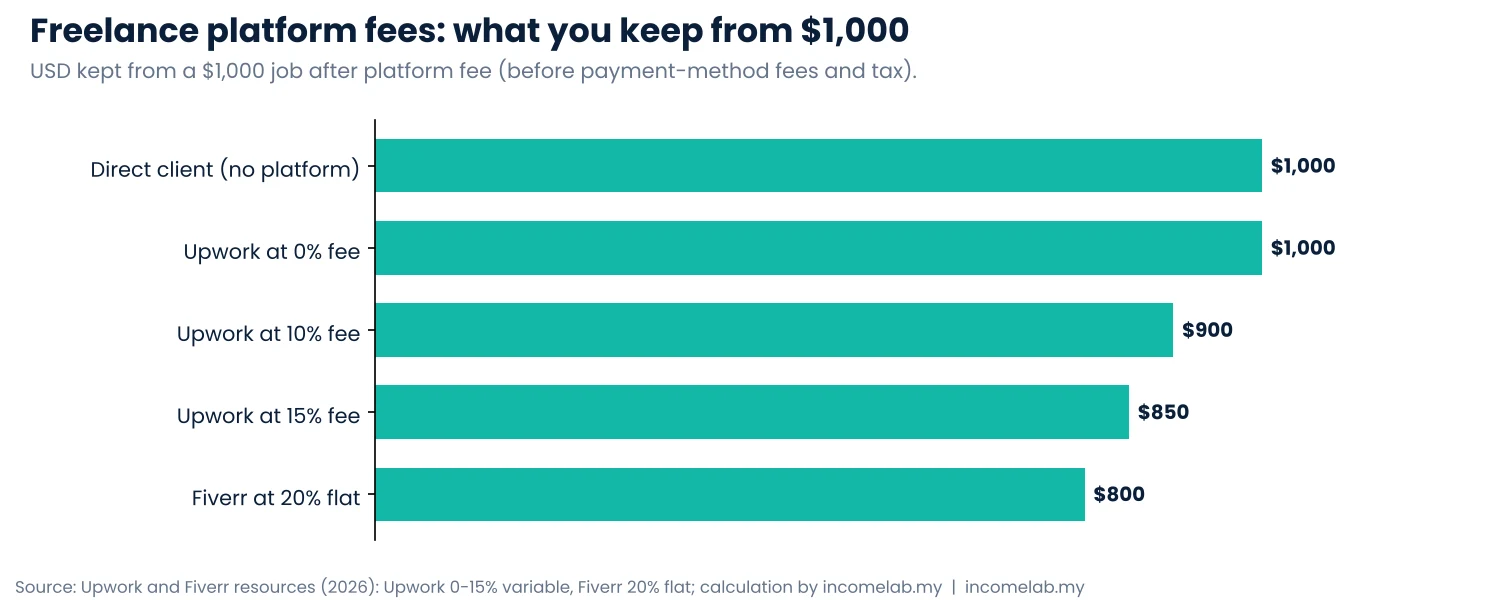
Figure 1. Illustrative take-home from a $1,000 job before payment-method fees and tax.
Side-by-side comparison
| Factor | Upwork | Fiverr | Direct clients |
|---|---|---|---|
| Fee to freelancer | 0% to 15% (varies); direct contracts up to 5% | Flat 20% | $0 (your own payment fees) |
| Plans | Basic free; Freelancer Plus $19.99 a month | Free; Seller Plus $29 to $45 a month | n/a |
| How you get work | Submit proposals (Connects; 10 free monthly on Basic) | Buyers browse your Gigs | Outreach, referrals, content |
| Pricing | Hourly or fixed | Flat-rate Gig packages; hourly only for Fiverr Pro | Your choice |
| Payment protection | Yes, with dispute team | Escrow; payment released after approval | Your contract and deposits |
| Best for | Hourly and long-term work | Packaged, simple services | Established services and repeat clients |
Pros and cons
Upwork
- Pros: low-fee potential, hourly and fixed contracts, payment protection, large demand.
- Cons: Connects for proposals, competition, plan costs, fees can reach 15%.
Fiverr
- Pros: easy gig setup, escrowed payments, no need to apply for jobs.
- Cons: 20% commission, price pressure on packaged gigs, cancellations can hurt ratings, hourly limited to Pro sellers.
Direct clients
- Pros: you keep the full price, build relationships, set terms.
- Cons: you do all marketing, contracts and collections; no built-in protection.
Which should you choose by stage?
| Stage | Suggested approach |
|---|---|
| Brand new (0 clients) | Use a platform to build proof; also pitch directly |
| 1 to 5 clients | Raise rates; ask for testimonials; move repeat buyers direct where terms allow |
| Established | Focus on direct clients and retainers; use platforms for overflow |
Check each platform's rules before moving clients off-platform, as most restrict circumventing fees for a period.
How to use platforms well
- Niche your profile: one service, one client type.
- Show proof: three samples and real testimonials.
- Write specific proposals that reference the client's problem.
- Price from your target using rate ranges.
- Never take payments off-platform if it breaks terms; it removes protection.
Other channels
| Channel | Notes |
|---|---|
| Job boards (We Work Remotely, FlexJobs, RemoteOK) | Remote roles and contracts |
| Direct outreach and content | |
| Communities | Referrals |
| Your own site and email list | Long-term asset; see email list guide |
Illustrative example (not a real person)
A freelance editor earns $2,000 of work on Fiverr at 20% (keeping $1,600) and $2,000 on Upwork at a 10% fee (keeping $1,800). A direct client project of $2,000 keeps $2,000 minus any payment processing. The pattern shows why many freelancers shift to direct work as they gain proof; individual fees will differ.
Freelance contract checklist
- Scope and deliverables.
- Revisions limit.
- Deposit and milestones.
- Payment terms.
- Ownership and credit.
- Platform rules reviewed.
Frequently asked questions
Is Upwork better than Fiverr?
Upwork suits proposal-based and hourly work; Fiverr suits packaged gigs. Fee structures differ, so choose by how you sell.
How much does Upwork charge freelancers?
A service fee of 0% to 15% depending on factors including supply and demand, up to 5% on direct contracts, per Upwork's resource.
How much does Fiverr charge?
A flat 20% commission on all earnings.
Is it worth paying for Upwork Freelancer Plus?
At $19.99 a month it may help if you bid often, but test whether extra proposal capacity increases wins before committing.
Can I take clients off Upwork or Fiverr?
Platform terms usually restrict circumventing fees. Read the rules before moving clients.
Which platform is best for beginners?
Fiverr is simple to set up; Upwork offers more control over proposals. Many beginners use both while pitching directly.
Do platforms protect freelancers from non-payment?
Both offer payment protection systems (Upwork Payment Protection, Fiverr escrow), but direct work needs your own contracts and deposits.
How do I stand out on Upwork?
Niche profile, specific proposals, real samples and testimonials.
How do I stand out on Fiverr?
Clear gig titles, packages with tiers, strong images and fast communication.
How do I find direct clients?
Outreach, referrals, content and communities. Offer a clear package and case studies.
Sources
- Upwork vs Fiverr: 2026 Comparison Guide, Upwork (opens in a new tab)
- How much do freelancers make, Upwork (opens in a new tab)
- How to become a digital nomad, Airalo (job boards) (opens in a new tab)
Fees checked October 2026 from Upwork's own comparison page; terms change. Upwork's page is a competitor comparison, so verify with Fiverr's own pages. Not tax or legal advice.
- upwork
- fiverr
- freelance platforms
- fees
- direct clients
Keep reading
Freelancing
How to Start Freelancing in 2026: A Beginner's Guide to Skills, Pricing, Platforms and Your First Client
A step-by-step guide to start freelancing in 2026: choose a service, build samples, set rates, pick platforms, pitch clients and handle contracts and tax basics.

Freelancing
Freelance Rates by Skill in 2026: What to Charge as a Beginner, Intermediate and Expert
Published 2026 freelance hourly rate ranges for writers, proofreaders, consultants, PR, media buyers and more, plus how to set your own rate and avoid underpricing.

Freelancing
How to Price Freelance Work: A 7-Step Method That Isn't a Guess
Work out a price from your scope, total hours, costs and actual fees. Compare it with similar work, then review your estimate after delivery.

Freelancing
How to write a freelance proposal: scope, price and template
Start with the client's problem in their words, show a 3–5 step plan, give a clear price and end with one question. Templates included.