Loading page content...
A practical service playbook for web freelancers
Turn a checkout review into a service clients can understand.
A step-by-step field guide to finding mobile friction, documenting what you can prove, agreeing a safe scope, and handing over a clear retest plan.
Includes an original fictional audit, client intake checklist, proposal, scorecard, workflow infographic, and short walkthrough video.
Prefer a templates-only starting point? See the Mobile Checkout Audit Template Pack.
Clear scope · practical deliverables · no income guarantees
A practical delivery loop
Evidence before estimate
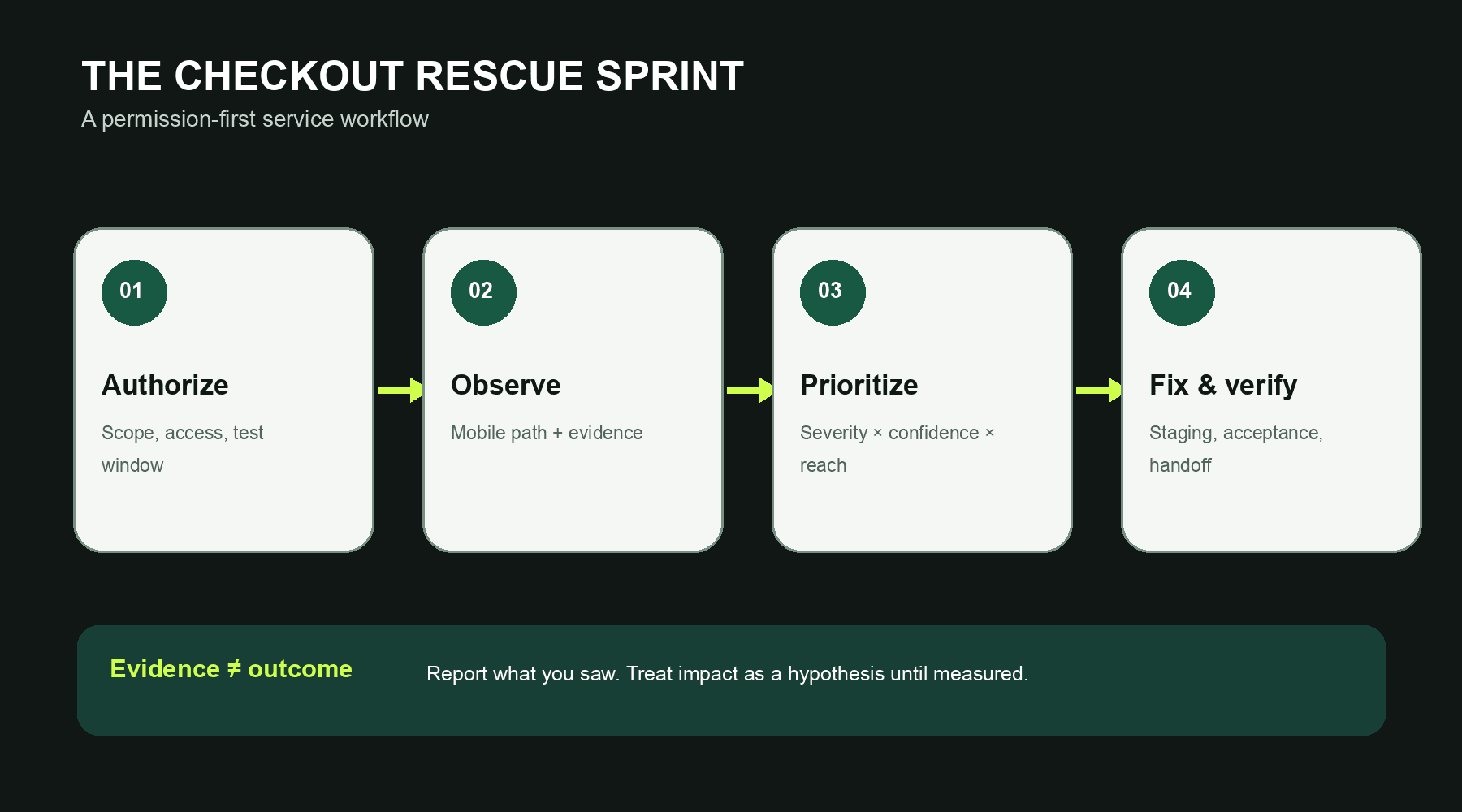
AuthorizeObservePrioritizeVerify
A permission-first method that separates observed behavior from business hypotheses.
A toolkit you can put to work
Build the deliverables, one step at a time
A specific workflow, with editable assets for the parts freelancers often have to invent from scratch.
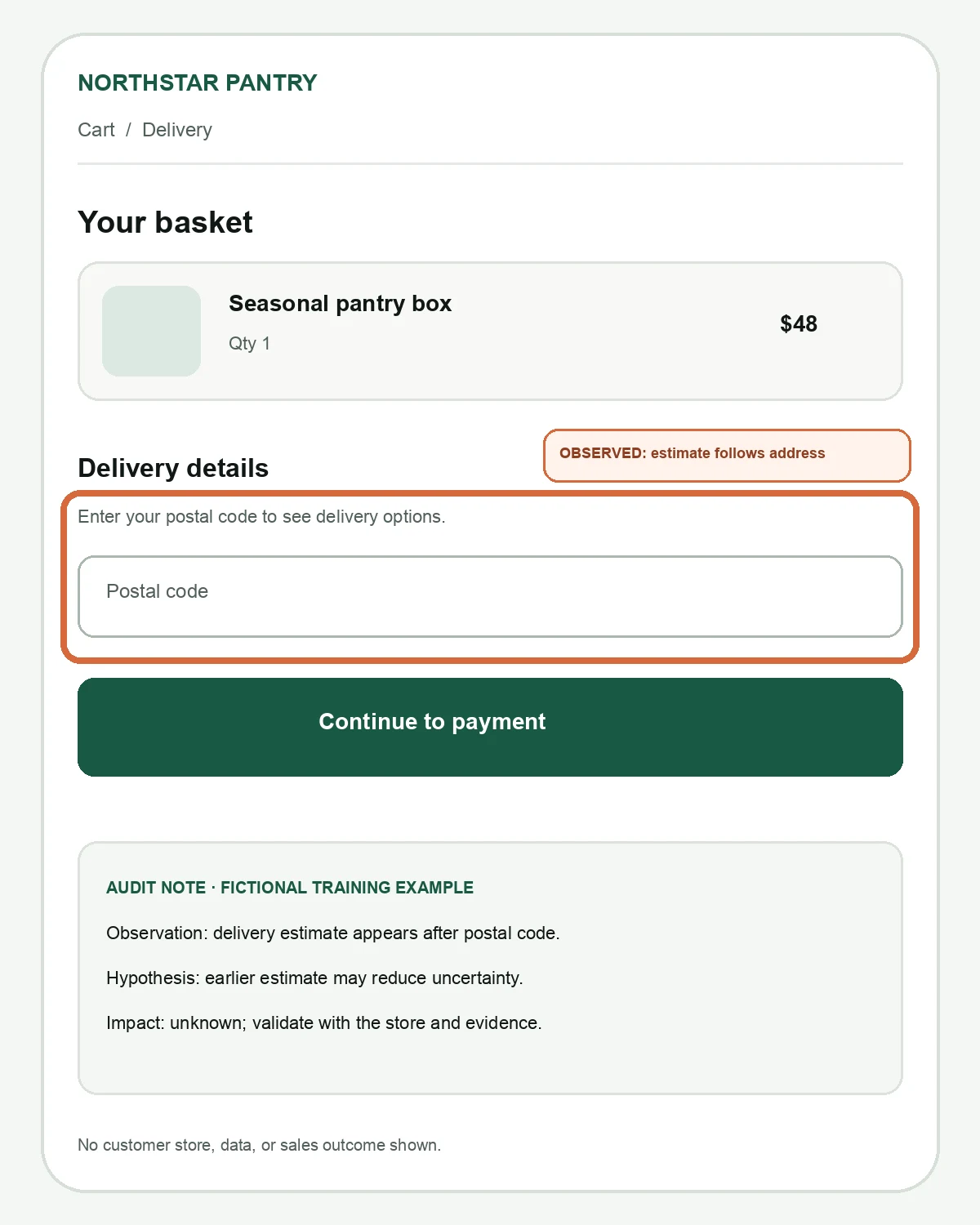
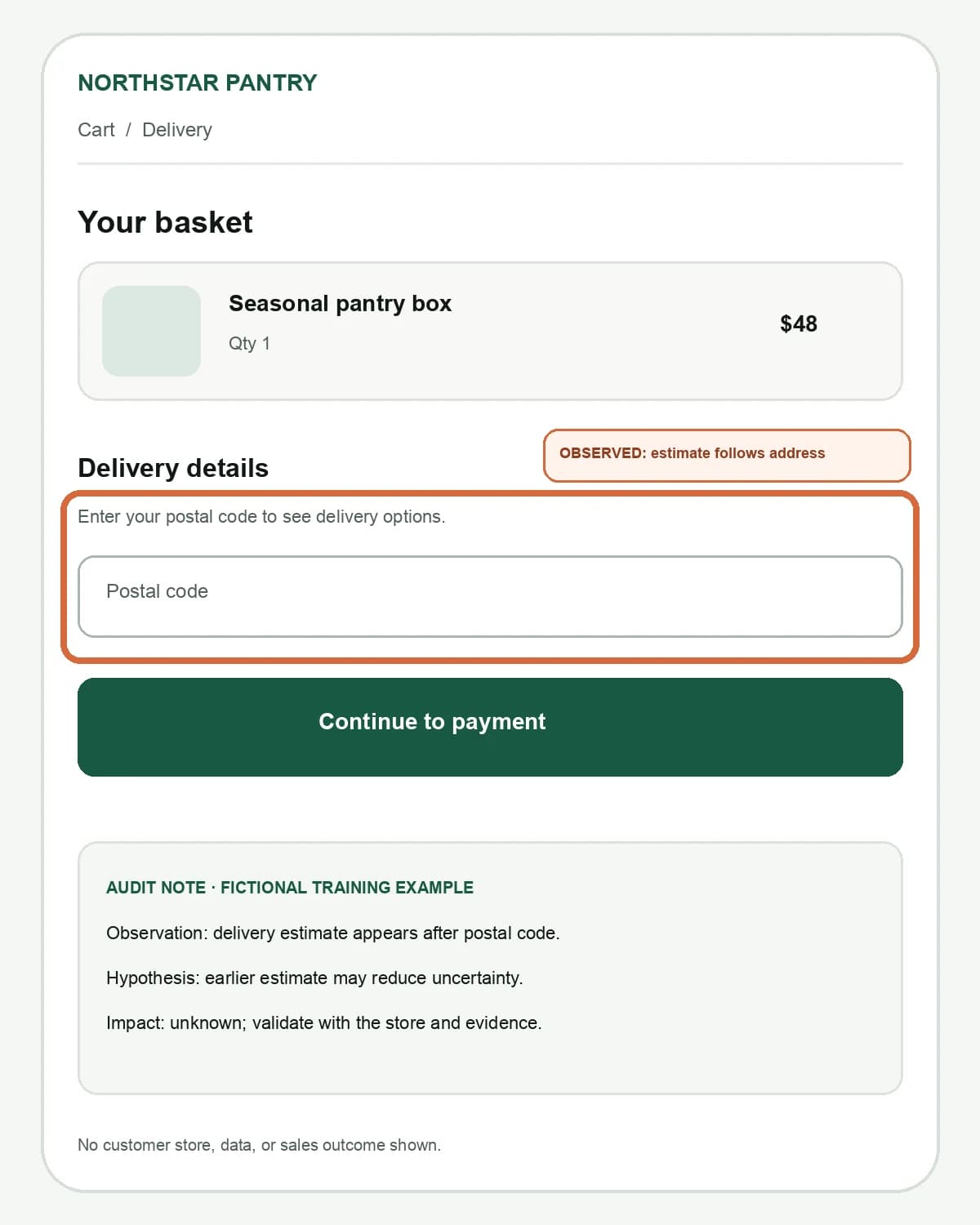 Inspect the mobile pathRecord the device, browser, checkout step, date, and reproducible behavior. Keep private customer information out of captures.
 Prioritize with a clear methodScore severity, confidence, and reach as a sorting aid; document unknowns instead of turning them into revenue claims.
Scope work you can verifyUse permission, exclusions, acceptance criteria, staging checks, and a client handoff to make the service concrete.
Research context, stated carefully
Why checkout UX is a reasonable skill area to explore
Upwork’s 2026 report describes demand signals on its own marketplace, including web design and ecommerce-related skills. That is a signal about adjacent work—not proof that buyers want this exact product or that a learner will get clients. Read the Upwork report (opens in a new tab).
Baymard’s 2025 benchmark reviewed 327 leading U.S. and European ecommerce sites and rated 63% of those sites’ checkout UX mediocre or worse. This is a scoped benchmark sample, not every online store and not evidence of any particular client’s lost sales. Read Baymard’s methodology and findings (opens in a new tab).
Google’s Core Web Vitals guidance gives technical thresholds for loading, responsiveness, and layout stability. Passing those thresholds is useful technical evidence; it does not prove conversion or revenue gains. See Google’s guidance (opens in a new tab).
The included US$2,000 scope is hypothetical arithmetic only. No IncomeLab customer results, testimonials, typical fees, or learner earnings are claimed.
From the download
What you will finish with
- A clearly defined buyer and service promise
- A permission-first client intake checklist
- A reproducible mobile checkout audit routine
- An issue scorecard with severity, confidence, reach, and effort
- A proposal template with exclusions and acceptance criteria
- A hypothetical project-scope worksheet to replace with your own costs
- A staging retest and handoff plan
- A four-week pilot and buyer-validation plan
The fictional walkthrough is a teaching visual, not a recording of a real client or a claim of results.
A 16-second fictional walkthrough
See the workflow before you decide
Permission → observation → prioritization → staging retest. The visuals are original training examples, not customer evidence.
The download also includes a narration script if you want to record your own version.
Clear boundaries
Before you decide
The product is designed to be useful without pretending outcomes are guaranteed.
Does this guarantee clients or income?
No. It teaches a repeatable workflow and includes editable assets. Client demand, skill, market, execution, and pricing vary; no result is promised.
Is US$2,000 the expected project price?
No. It is a hypothetical 18-hour scope exercise using an assumed rate and contingency. The product page shows a proposed launch price only; the final price and terms will be confirmed before checkout opens. It is not a market benchmark or a claim beginners can charge that amount.
Are the screenshots from a real customer?
No. The store and screenshot are fictional training assets created for this guide.
Can I buy it now?
The payment provider is not connected yet. This page only collects launch interest; no charge is taken. We will publish the final price and checkout terms before sales open.
What research supports the topic?
The guide links to Upwork marketplace signals, Baymard’s stated checkout benchmark sample, Google’s performance guidance, and FTC endorsement guidance. These support context and ethical framing, not product-specific demand or earnings.
Follow the product build
Get the launch note
Register interest and receive an update when the guide is ready for review. No payment is taken here.
A practical next step
Learn the method. Test the offer. Keep the evidence honest.
Use the guide to build a sample workflow, then validate it with real target buyers before treating it as a business offer.
Payment setup is still pending. This is an interest page, not a live checkout.
Prelaunch · interest only · no charge taken