Loading ebook details...
Bundle
The AI Desk
Three coordinated books with current files and a practical internal exercise
4.9(40)
|Editorial review 4.4/5The problem
The prompt guide, the skill guide, and the freelance guide are easy to buy as three abandoned tabs.
Who it's for
Freelancers and marketers who want one shelf for prompts, skill cards, and a scoped offer.
The method
Prompt, then skill, then offer
What you save
Bought one by one$63
This bundle$47
How the method works
Prompt, then skill, then offer: the path the book takes you through, step by step.
- ChooseOne permitted project and the included title that supports its next task
- ReadCurrent guide and dated corrections before the retained original section
- PracticeMatching worksheet, actual result and evidence; essential failures remain held
- ConnectReconcile facts, units, scope and permission across books before any intended next action
What you'll be able to do
Use one project to connect current instructions, matching templates and explicit checks. No provider result, physical proof, client, publishing acceptance or income is promised.
Is this book right for you?
One desk: a checked prompt, a skill card for a real job, and an AI offer with scope
The AI Desk contains 3 named books in one 242-page PDF. It retains all 209 original compiled pages and adds the current how-to and dated correction pages for every included title. Use the PDF bookmarks or BUNDLE-START-HERE.md instead of the old printed page map.
Included titles: Local Prompt Bench; Offer Skill Bench; AI-Powered Freelancing.
The 52 companion files match the current individual downloads and keep every original path. The extracted templates folder and the separate ai-desk-templates.zip provide two matching ways to open them. A file index records paths and hashes; thirteen planned project checks help reconcile facts, prices, permissions and handoffs across books. Some files have fictional filled examples; there is no claim that every blank has one.
Choose one permitted project and extend the suggested reading calendar as needed. Scorecard thresholds do not waive essential checks or require a live profile, twenty messages or a production automation. The automation JSON files, where included, are inactive configuration templates with local synthetic checks, not verified live integrations. No clients, income, actual demand or production result is promised.
Local catalog price check, 14 November 2026: $47 for this bundle; $63 for its included titles separately. The comparison uses the catalog listed prices, not evidence of a completed checkout.

Practice outcome
Current guide and corrections for each included title
Practice outcome
52 matching companion files with their original paths
Practice outcome
One combined searchable PDF with preserved bookmarks
Practice outcome
Current reading map, companion hashes and thirteen planned project checks
What you can inspect
- Local file check, 11 November 2026: 242 total pages, all 209 original pages and original bookmarks retained. Compiled chapter texts matched to completed individual-title reviews; bundle front matter reviewed separately.
- Packaged 52 companions byte-matched to current individual downloads, with a matching templates ZIP and SHA-256 index.
- The thirteen project-check rows start blank. File consistency is not an actual cross-book practice, provider integration, public deployment or independent reader trial.
- Local catalog price check, 14 November 2026: $47 for this bundle; $63 for its included titles separately. The comparison uses the catalog listed prices, not evidence of a completed checkout.
Why this book exists
On a Sunday night the shelf had too many tabs and not enough finished work. The desk version is the cut: prompt first, so the next chat starts from a brief; skill card second, so a repeated job has instructions; freelance guide third, so the offer has scope, price, and a stop. One download. Three jobs. The rest of the catalogue can wait.
What's inside
- 242-page compiled guide retaining all 209 original pages, with current corrections for all three books
- 52 synchronized current template files plus matching templates ZIP and hash index
- Complete current individual kits under included-kits/, including root notes and finished exercises
- One completed internal desk exercise, scoped answer key and native review forms
- Offline needs/ownership price calculator; original licences and published price preserved
The 3 books in this bundle
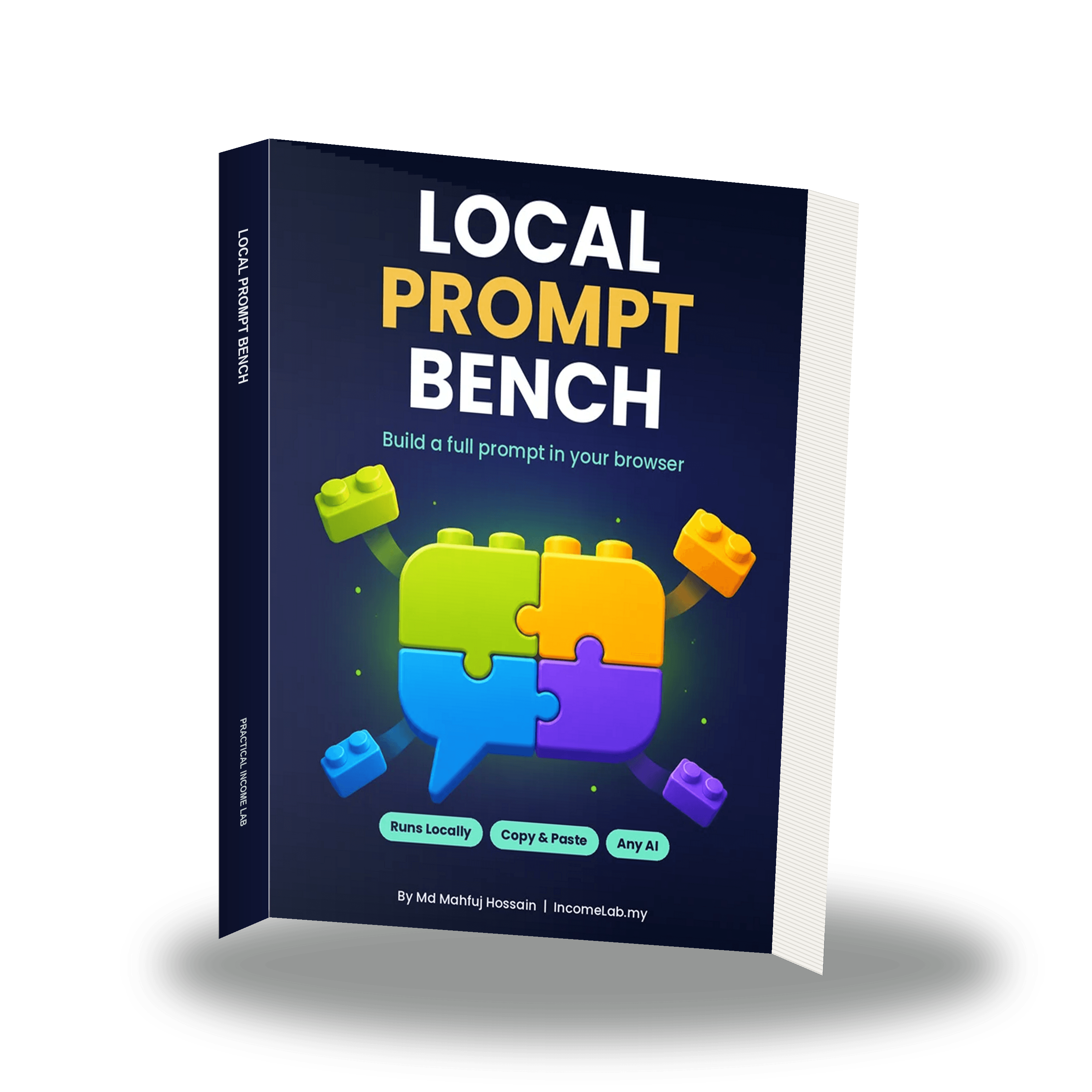
Local Prompt Bench
A seven-line prompt frame, a scoring sheet and 30 ready prompts to fix the first message before you send it
$17 on its own

Offer Skill Bench
Ten standing jobs for Claude or any assistant that can hold instructions
$24 on its own
- AI / FreelancingAI-Powered Freelancing
AI-Powered Freelancing
A measured approach to AI assistance, review and client delivery
$22 on its own
Chapters
- 01Practical walkthrough and dated bundle note: PDF pages 1–7
- 02Local Prompt Bench — current guide/corrections: PDF pages 8–17
- 03Offer Skill Bench — current guide/corrections: PDF pages 18–26
- 04AI-Powered Freelancing — current guide/corrections: PDF pages 27–33
- 05Local Prompt Bench — retained original section: PDF pages 38–100
- 06Offer Skill Bench — retained original section: PDF pages 101–160
- 07AI-Powered Freelancing — retained original section: PDF pages 161–242
Read a free sample
No email needed. This is the book's real text, unedited.
Dated lab clarifications, 11 November 2026: use the current inserted title notes and revised companions before these retained extracts. Timings and score thresholds are planning aids, not proof or permission. Keep an unchanged baseline or no fault observed when accurate; do not invent interviews, drawbacks, faults or improvements. A fifteen-to-twenty-percent price rise is an optional scenario, not a rule. Do not force three exclusions or one-page terms at the expense of material information. Use synthetic or authorized source data; public availability is not unrestricted copying or AI-upload permission. Automation practice starts inactive and isolated; one week cannot establish four Friday observations. Record actual events and extend the schedule. An internal draft or held release can be the correct result.
Start here
The outcome
By day 7 you will have a finished Prompt Bench: a personal library of at least 12 tested prompts (nine task types, 30 ready-made starters to adapt), each one built on the same seven-line frame, each one scored on a one-page bench sheet, and each one stored with the facts it needs and the sentences it must never invent. You will also have run one prompt against three different outputs and decided, with numbers, which version to keep.
This is a process promise, not an income promise. Nothing here guarantees that a model gets every sentence right. The method makes errors cheaper to find, because the prompt tells the model which facts exist, which do not, and what to do when a fact is missing. Every example in this book is invented for teaching and labelled HYPOTHETICAL EXAMPLE (or ILLUSTRATIVE). None is a real customer, a real test of a named product or a real result.
Who this is NOT for
- People who want a "magic prompt" that works for every job. There is none, and Chapter 2 explains why.
- People who need legal, medical or financial advice from a model. A model can draft and organise; it cannot take responsibility for facts you did not check.
- Developers building API pipelines. This is a workbook for people typing into a chat window, not a framework.
Time needed
| What | Time |
|---|---|
| 30-minute quick start (Chapter 1) | 30 min |
| Chapters 2 to 4: the method | about 90 min |
| Chapters 5 to 8: nine task types | 3 to 4 hours, with a prompt run after each |
| Chapters 9 to 11: scoring, testing, saving | about 90 min |
| 30 ready prompts (Chapter 12) | use as needed |
| 7-day practice plan (Chapter 13) | 30 to 45 min a day |
How to use this book
Read a chapter, then do its exercise on a real job you need this week. Each module has a concept, a hypothetical worked example, a timed exercise with a Done when box, a template, yes/no self-checks and an If you get stuck box. Answer keys are in Chapter 15: try first, check after.
The free tool on the incomelab.my site is the practice version of this method: a form that assembles a prompt in your browser so you can copy it. This book works with or without it. Everything in it can be done in a plain text file.
Your route through the book
- Quick start: Chapter 1, 30 minutes
- Method: Chapters 2 to 4
- Nine task types: Chapters 5 to 8
- Score and test: Chapters 9 to 11
- Library and plan: Chapters 12 to 13
- Ship: Chapters 14 to 16
Reading map
| If you are... | Read first | Then |
|---|---|---|
| A freelancer who hits usage limits mid-draft | Ch 1, Ch 2 | Ch 3, Ch 6 |
| A creator who writes sales pages and emails | Ch 3, Ch 7 | Ch 4, Ch 9 |
| A researcher or student | Ch 4, Ch 8 | Ch 10 |
| Someone who just wants prompts now | Ch 12 | Ch 3 to fix any that fail |
What is in the template pack
A blank Bench Prompt template and a filled fictional one (.docx), a prompt-scoring workbook with formulas (.xlsx), a three-output comparison workbook (.xlsx), a fact-pack sheet (.docx), the 30 starter prompts as .csv and .md, and a 7-day practice log (.csv). Every filled file is marked FICTIONAL.
Thirty minutes to your first Bench Prompt
You do not need the whole book to improve your next prompt. This quick start takes one real job from "vague message" to "bench prompt" in thirty minutes, with a timer.
Minute 0 to 5: pick one real job
Choose something you must produce this week: an outline, an email, a comparison, a lesson, an image brief. Write it down in one sentence in the form "I need a [thing] for [person] by [when]." If you cannot say it in one sentence, the job is two jobs. Pick one.
Hypothetical example: the starting message
Invented person "Aiman", a freelance bookkeeper. Not a real person.
His first message to a model: "Write something about bookkeeping tips for small businesses." The model asks three questions, then writes 700 generic words. Aiman spends the next twenty minutes steering. That is the expensive first message.
Minute 5 to 15: fill the seven lines
The Bench Prompt has seven lines. Write one sentence for each, in your own words.
| Line | Question it answers | Aiman's line (hypothetical) |
|---|---|---|
| 1. TASK | What finished thing do I want? | A 5-point checklist email |
| 2. READER | Who reads it and what do they already know? | Owners of cafes with 1 to 3 staff, no accounting training |
| 3. OUTPUT | What shape, length and order? | Subject line, 120-word intro, 5 numbered points, one-line sign-off |
| 4. FACTS | What do I already know that is true? | (pasted: his three real service tiers and prices, labelled "mine") |
| 5. LOCK | What must the model not invent? | No statistics, no tax rules, no client stories, no prices other than the ones above |
| 6. LIMITS | What must it avoid or stay inside? | Plain English, no jargon, under 250 words, no emojis |
| 7. CHECK | What should it do before and after drafting? | List assumptions first; after the draft, list every claim that came from my facts and every claim that did not |
Minute 15 to 20: assemble and paste
Put the seven lines in one message, in that order, each starting with its label in capitals. The seven lines are the whole method. The rest of the book is how to write each line well for nine kinds of task.
Minute 20 to 28: run once, then circle
Read the model's reply with a pen (or a highlighter). Circle every sentence that states something you did not give it. These circles are your invention list. Do not fix the draft yet.
Minute 28 to 30: write the fix
For each circle, add one line to LOCK or FACTS. Either you supply the fact, or you forbid the invention. Save the new version with a name and today's date.
Quick start checklist
- Chose one job and wrote it as one sentence
- Filled all seven lines
- Ran the prompt once
- Circled every invented sentence
- Added at least one fix to FACTS or LOCK
- Saved the prompt with a name and a date
Done when
You have a saved prompt with seven labelled lines, an invention list from one real run, and at least one new LOCK or FACTS line that came from your circles.
Self-check
- Can I say the job in one sentence? (yes/no)
- Does every one of the seven lines have a sentence? (yes/no)
- Did I circle invented sentences before editing the draft? (yes/no)
- Did I save the prompt with a date? (yes/no)
Stuck?
- The model asked questions instead of drafting. Add the answers as FACTS, and add the line "If a fact is missing, list it under MISSING and still draft with placeholders."
- Nothing was invented, so no circles. Good. Check LIMITS: was the format right? Circle format misses instead.
- You cannot fill FACTS. Then the job needs research first (see Chapter 8, the research brief) before it needs a draft.
Why the first message is the expensive one
Every chat has a budget: your time, the model's context window and, on many plans, a usage allowance that resets after a period. Plans, limits and prices change, so check current terms on your own plan. What does not change is where the budget goes. It goes on the repair loop: the back-and-forth after a weak first message.
Version 2.0-r20261109 · changelog
- 2.0 (2 November 2026): Rebuilt from the v2.0 guides: the desk PDF now contains the three rebuilt titles in full (209 pages, about 58,800 words) with a start-here page, plus a combined 48-file template folder. Removed the line about free companion tools, which is not part of the download.
- 1.0: Desk edition. Prices of the included books are listed on their own pages. 9 November 2026: revised practical walkthrough, editorial corrections and checked local deliverables. 11 November 2026: original compiled PDF retained with current included-title correction appendices; bundled companions synchronized to individual downloads, a matching templates ZIP added and current reading map/file hashes supplied. Schedules, score gates and old file/page-count claims corrected.
Pairs well with
- Planned · $17
AI Tools
36/40Local Prompt Bench
A seven-line prompt frame, a scoring sheet and 30 ready prompts to fix the first message before you send it
See what's inside4.8(27) - Planned · $24
AI / Marketing
36/40Offer Skill Bench
Ten standing jobs for Claude or any assistant that can hold instructions
See what's inside4.9(31) - Planned · $22AI / FreelancingAI-Powered FreelancingA measured approach to AI assistance, review and client delivery
AI / Freelancing
36/40AI-Powered Freelancing
A measured approach to AI assistance, review and client delivery
See what's inside4.9(63) - Planned · $49

Bundle
36/40The AI at Work Bundle
Prompting, AI-assisted freelancing, an AI side hustle and automation: four books in one PDF, done carefully
See what's inside5.0(71)