Work From Home
How to Spot Work-From-Home Scams in 2026: 12 Red Flags, Task Scams and What to Do If You Were Targeted
Learn the red flags of fake work-from-home jobs, how task scams work, how to verify an employer, and what to do if you have already paid or shared details.
By Md Mahfuj HossainPublished 5 min read
Quick answer: Treat any job that asks you to pay to get hired or to get paid, contacts you first on a chat app, offers high pay for easy tasks, or hires you with no interview as a likely scam. The FTC has reported that job-scam losses rose more than threefold between 2020 and 2023, and that reports of "gamified" task scams jumped from about 5,000 in all of 2023 to about 20,000 in early 2024. The FTC also says only a small share of victims report, so true losses are higher.
Key takeaways
- Never pay to get paid, or to get a job.
- Task scams (liking videos, rating products) show fake earnings and then demand deposits, often in crypto.
- Verify the company independently before sharing documents or bank details.
- If you were scammed, stop paying, keep records, and report it.
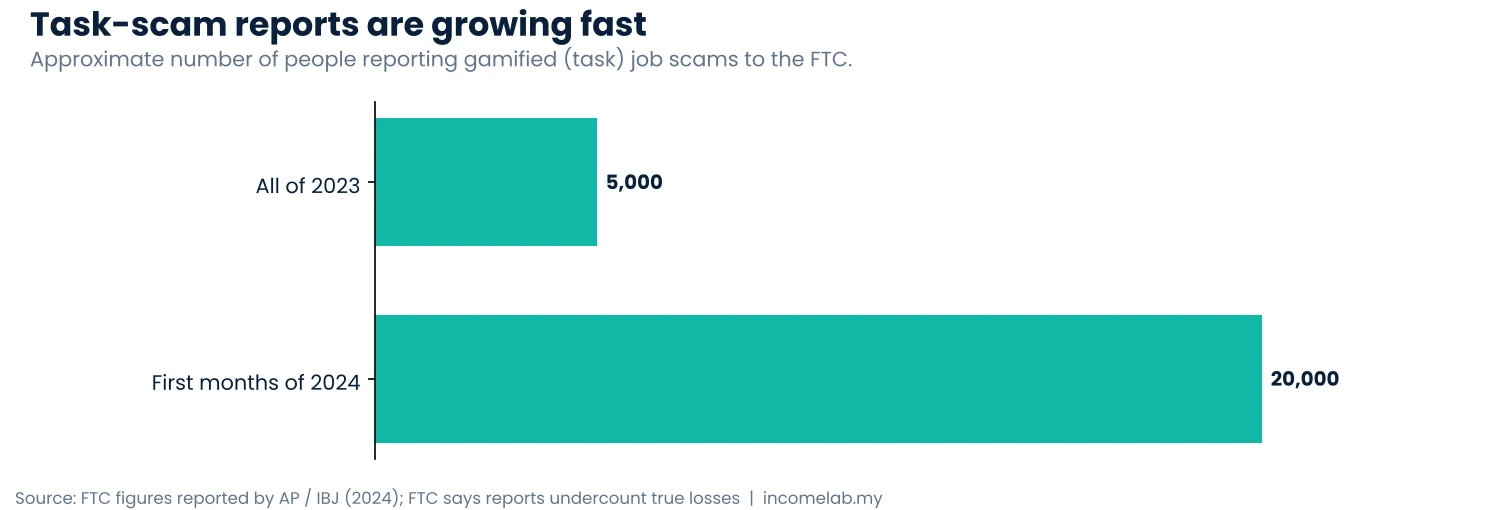
Figure 1. Approximate FTC-reported task scam numbers as cited by AP/IBJ. The FTC says reports undercount real losses.
The 12 red flags
| # | Red flag | Why it matters |
|---|---|---|
| 1 | Asked to pay for training, software, a "starter kit" or a background check | Real employers pay you |
| 2 | A recruiter messages you first by text, WhatsApp or Telegram | Common scam entry point |
| 3 | No interview, instant hire | Real hiring takes steps |
| 4 | Pay is far above market for simple tasks | Bait |
| 5 | Tasks are liking, rating or boosting products | Typical task scam |
| 6 | Fake dashboard shows earnings but you must deposit to withdraw | Classic advance-fee trick |
| 7 | Asked to cash a cheque and send some back | Cheque fraud |
| 8 | Asked to receive and forward packages | Reshipping scheme |
| 9 | Vague job description or company details | No real employer |
| 10 | Email from a free address (gmail, outlook) pretending to be a company | Impersonation |
| 11 | Pressure and urgency | Stops you checking |
| 12 | Asked for passport, bank login or social security number before a signed offer | Identity theft |
How task scams work
According to the FTC's description, victims are recruited for online "optimisation" tasks, such as rating product images, for supposed commissions. A fake platform shows growing earnings, but to withdraw you must deposit your own money, often via cryptocurrency. Early flattery and easy hiring are part of the playbook.
Comparing legitimate vs fake offers
| Legitimate employer | Scam | |
|---|---|---|
| Contact | You applied, or they reply to your application | They contact you unprompted |
| Hiring | Interview, written offer | Instant "hire" |
| Costs to you | None | Fees, deposits, "equipment" |
| Pay | Stated in the offer, paid by the employer | Paid in commissions you must unlock |
| Payment method | Payroll or invoice | Crypto, gift cards, wire |
| Company | Verifiable website and address | Vague or copied |
A 10-minute verification checklist
- Search the company name plus "scam" and "reviews".
- Check the company's official site and find the job on its careers page.
- Confirm the recruiter's email domain matches the company.
- Look up the company registration in your country.
- Ask for a video interview.
- Never send ID or bank details before a written offer and contract.
- Never pay.
What to do if you've been targeted
- Stop all payments and stop replying.
- Save evidence: messages, screenshots, wallet addresses, receipts.
- Contact your bank or card issuer quickly if you paid.
- Change passwords if you shared logins and enable two-factor.
- Report it to your national consumer protection agency (in the US, the FTC) and the platform.
- Watch for recovery scams that promise to get your money back for a fee.
Safer ways to find online work
Use known job boards, company career pages and freelance platforms, and read our guides to entry-level remote jobs and online income methods. Be equally careful with "make money online" courses and income claims, including those about AI (see our AI hype guide).
Illustrative example (not a real person)
A message says: "Earn $200 a day liking videos. No experience needed." After a few tasks the app shows $400 in earnings, but to withdraw, the user must deposit $300 for "account verification". This pattern matches the FTC's description of task scams, and the correct response is to stop and report.
Frequently asked questions
How can I tell if a work-from-home job is a scam?
Look for requests to pay, unsolicited recruiters on chat apps, instant hiring, high pay for easy tasks and vague employer details.
What is a task scam?
A scam where you are paid small amounts for tasks like rating products, then asked to deposit money to unlock bigger earnings or withdraw funds.
Do legitimate jobs ever ask for money?
No. You should never pay to get a job or to get paid. Employers may ask for ID after a signed offer, but not fees.
Why do scammers contact people on WhatsApp?
It is direct, hard to trace and feels personal. The FTC lists unexpected texts or WhatsApp messages as a warning sign.
What should I do if I paid a scammer?
Stop paying, keep records, contact your bank, change passwords and report to your consumer protection authority.
Can I get my money back?
Sometimes, especially with quick bank or card action, but it is not guaranteed and crypto payments are hard to recover. Beware recovery scams.
Are all online jobs scams?
No. Many legitimate remote jobs exist. Verify each employer.
How do I check a company is real?
Check its official site, careers page, registration, reviews and recruiter email domain.
Is data entry from home a scam?
Many "data entry" ads are scams; legitimate roles pay hourly or salary with a contract. See our role list.
Where do I report job scams?
Use your national consumer agency; in the US that is the FTC at reportfraud.ftc.gov. Also report to the platform where you saw the ad.
Sources
- Job scams are rising, FTC says (AP via IBJ) (opens in a new tab)
- 25 remote jobs you can start now, ConsumerAffairs (opens in a new tab)
Information checked October 2026. General safety information, not legal advice.
- scams
- work from home
- job scams
- online safety
- fraud
Keep reading

Work From Home
Home Office Setup in 2026: Three Budgets, an Ergonomic Checklist and a $392 Sample Build
How much a home office really costs in 2026, with basic, mid and premium budgets, a $392 ergonomic sample build, ergonomic rules, and what to buy first.
Work From Home
Remote Jobs With No Experience in 2026: 25 Entry-Level Roles, Pay and How to Get Hired
A practical guide to entry-level remote jobs in 2026, with approximate pay for 25 roles, the skills each needs, how to build a first-job profile, and how to avoid scams.

Work From Home
Remote vs Hybrid vs In-Office Work in 2026: Productivity, Pay, Costs and Who Each Suits
A balanced comparison of remote, hybrid and in-office work in 2026: what research says about productivity and retention, costs, career trade-offs and how to choose.

Work From Home
Work From Home Productivity Guide 2026: Schedules, Focus Blocks, Tools and Boundaries That Work
A practical guide to staying productive when working from home: a daily schedule, focus-block method, tool stack, boundary rules and a comparison of common techniques.