Loading ebook details...
Puzzle Books
Case Grid Press
A three-by-three logic puzzle the tool has checked for a single solution
4.9(32)
|Editorial review 4.5/5The problem
A logic grid that still has two solutions wastes the solver's time, and you cannot see that by reading it once.
Who it's for
People assembling deduction puzzles for a printable, a classroom, or a short book
The method
The Unique Grid
Inside this book
- 19chaptersOne method, explained step by step
- 30day planA small action for every day
- 1free toolCase Grid Press
How the method works
The Unique Grid: the path the book takes you through, step by step.
- SolveFollow the actual grid guide and study workshop
- GenerateCreate a new versioned practice JSON with the supplied command
- CheckRun both evaluators and review exact final wording, labels and key
- Lay outInspect matching-paper output and actual source/route requirements
What you'll be able to do
Create and inspect a three-person logic case with a matching key, using a complete study workshop and versioned local checks. House tiers do not establish measured reader difficulty, physical print quality, resale permission or publishing acceptance.
Is this book right for you?
Logic-grid cases with one provable solution, twelve ready to print
Case Grid Press teaches a small, fully enumerable puzzle format: three people, three rooms and three objects. The 91-page revision retains every page of the eighteen-chapter original and adds current illustrated instructions.
Start with the finished nine-file workshop: twelve study puzzles and separate answer keys in Letter and A4, a three-page guide showing real grid deductions, and an offline page with markable cells. Then generate your own practice JSON with a simple command, check it in both evaluators, and lay out a matching puzzle/key pair.
The 50 companions include the twelve source cases and text keys, current Python tools, two editable workbooks and two Word templates. The revised second evaluator no longer shares the first evaluator’s clue logic. Fifteen original checks and seventy-six added checks passed; the workbooks passed thirty-six synthetic Calc cases and fifty-two assertions.
At $27, this is a conditional choice for a creator who wants the source and workflow. Free printable collections are a better starting point if you only want puzzles to solve. The original cases remain study examples; generate and record your own for a commercial booklet. Physical print, independent reader/classroom trials, rights clearance, platform acceptance and sales have not been established.
Practice outcome
A versioned practice case and matching key
Practice outcome
A complete reference workshop to solve and adapt for practice
Practice outcome
Separately evaluated formal clue checks
Practice outcome
An evidence record for final-file review
What you can inspect
- All 78 original pages and 47 original companion names retained.
- Twelve source cases, printed clues, keys, scores and curves reconciled; 900 original generation attempts reproduced.
- 15 original and 76 additional local checks passed, including 153 individual clues and an injected evaluator fault.
- Both workbooks passed 36 actual Calc fixtures/52 assertions.
- The offline workshop’s twelve cases, keyboard marking/reset/reveal and both browser Copy outputs were checked locally. No physical print or independent reader trial performed.
Why this book exists
Noor liked puzzle books and disliked the ones where clue four contradicted clue two. She typed three names she liked, three rooms in a house, and three objects on a table. The press returned a set of clues and one filled grid.
She solved it on paper without looking, then checked. It matched. She changed one name, ran it again, and had a second case. The book started as a stack of grids she could verify, which is the only kind she was willing to sell.
What's inside
- 91-page illustrated revision retaining all 78 original pages and 199 bookmarks
- 50 companions retaining all 47 original names, under templates/ and in a matching templates ZIP
- Complete nine-file workshop: twelve study puzzles and separate keys in Letter/A4, three-page visual guide and offline markable grids
- Python solver and generator preserve all eight forms/APIs, with a simple generation command and additional schema/independence checks
- Two revised workbooks, two enriched Word files, preserved CSV/register and original case JSON/text
- Both supplied case PDFs now have current Letter layouts plus every original reference page
- Numbered current steps, clue-count corrections, buyer comparison and sourced publishing guidance
Chapters
- 01Start here
- 02The 30-minute quick start
- 03What the grid is
- 04How the check works
- 05Clue forms and clue craft
- 06Building a case from a seed
- 07Difficulty you can measure
- 08Reading a failed seed
- 09The solver's page: layout and printing
- 10The twelve cases
- 11Answer keys and walkthroughs
- 12Assembling a booklet and its answer keys
- 13KDP and Etsy: listing guidance, cited
- 14Licence, names and originality
- 15Fourteen days, one deliverable a day
- 16Capstone, scorecard and ship-it
- 17Answer keys and model answers
- 18FAQ, glossary and changelog
- 19Sources
Read a free sample
No email needed. This is the book's real text, unedited.
Start here
The outcome
By day 14 you will have a finished case booklet kit: twelve to twenty-four three-person logic cases, each tested so that exactly one answer fits all its clues, with answer keys that show how the clues narrow the field, a page layout for print, a listing that says only what the files deliver, and a tested Python solver and generator so the check does not depend on your patience. The pack includes twelve complete cases made and verified by us, the solver (solver.py), the generator (case_gen.py) and a test suite with planted faults.
This is a process promise, not an income promise. Nothing here guarantees sales, rankings or royalties. Every invented example (people, shops, numbers) is labelled HYPOTHETICAL EXAMPLE or FICTIONAL. The twelve cases' characters are fictional too. Every outside fact (KDP and Etsy rules, the description of logic grid puzzles) is dated checked Nov 2026 and listed in the final chapter. Platform rules change, so check the live page before you upload.
Who this is NOT for
- Anyone who wants hundreds of different puzzle types. This guide covers one small, fully checkable type: three people, three rooms, three objects.
- Anyone who wants a story-writing course. The cases have a short story shell; the craft here is in the clues.
- Anyone who needs legal advice on trademarks or licences. The licence chapter gives questions to ask.
Time needed
| What | Time |
|---|---|
| 30-minute quick start (Chapter 1) | 30 min |
| Theory and the solver (Chapters 2 and 3) | about 2 hours |
| Clue craft, building cases, tiers, failed seeds (Chapters 4 to 7) | 3 to 4 hours |
| Layout and the twelve cases (Chapters 8 to 10) | 1 hour reading, plus solving time |
| Assembly, listing, licence (Chapters 11 to 13) | 3 hours |
| 14-day plan (Chapter 14) | 45 to 90 minutes a day |
How to use this book
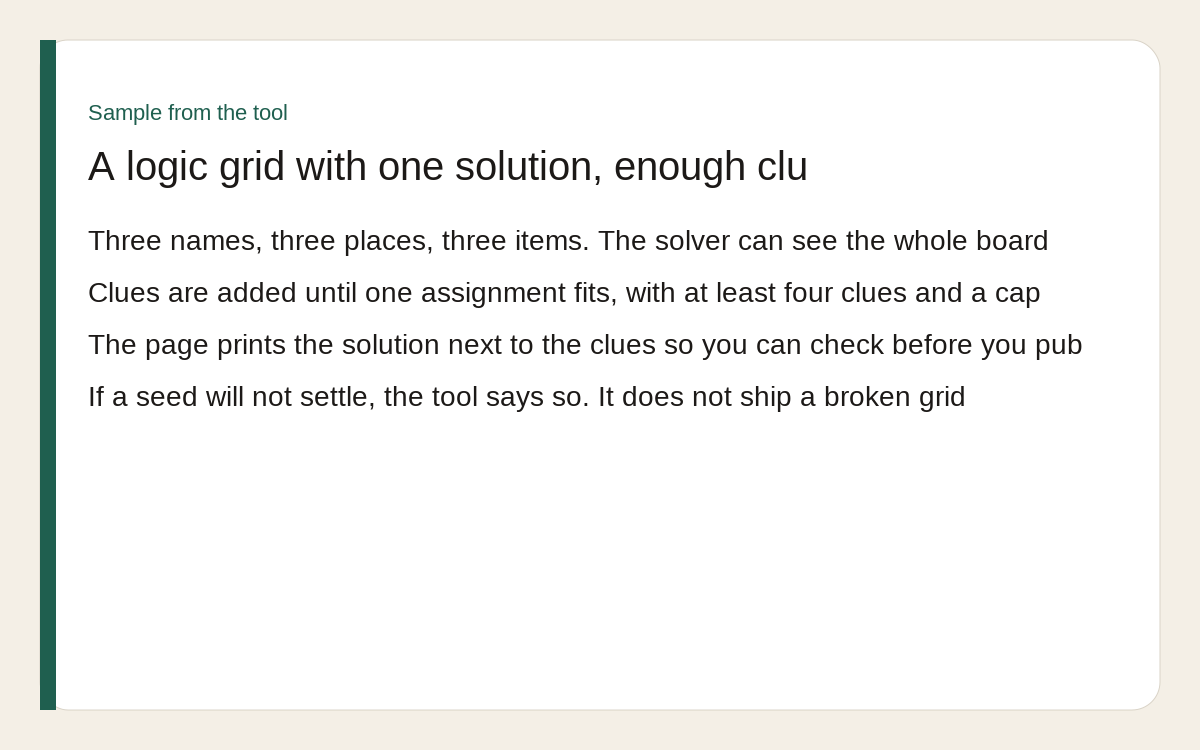
You can work with the free Case Grid Press tool on the incomelab.my site or with the Python scripts in the template pack, or with both. The tool builds a deduction with three named people, three rooms and three objects, tries clues until a full search of the possible assignments leaves a single match, and prints the solution next to the clues so you can check before you publish; if a seed will not settle, it says so. Its check is exhaustive because the case is small: the page's own wording is that it stays at three people so the test is exhaustive, not a sample. This book teaches the same method and gives you a second implementation you can run and read. Our script uses its own seeds, so a seed in this book will not necessarily match the same number on the site; record which one you used.
Each module has a concept, a hypothetical worked example, a timed exercise with a Done when box, a template, yes/no self-checks and an If you get stuck box. Model answers are in Chapter 16.
Your route through the book
- Quick start: Chapter 1, 30 minutes
- Theory and solver: Chapters 2 and 3
- Craft: Chapters 4 to 7
- The twelve cases: Chapters 8 to 10
- Publish: Chapters 11 to 13
- Ship: Chapters 14 and 15
Reading map
| If you are... | Read first | Then |
|---|---|---|
| A solver who wants to learn the method | Ch 1, Ch 2, Ch 9 cases | Ch 10 walkthroughs |
| A teacher making puzzles for a class | Ch 1, Ch 4 clue craft, Ch 6 tiers | Ch 8 layout, Ch 11 assembly |
| A KDP puzzle publisher | Ch 8, Ch 11, Ch 12 | Ch 13 licence, Ch 14 plan |
| A programmer | Ch 3, Ch 5, Ch 7 | the code in the pack |
| Short of time | Ch 1, Ch 3, Ch 15 | 14-day plan, compressed |
What is in the template pack
| File | What it is |
|---|---|
| solver.py | Exhaustive solver, a second independent backtracking solver, clue text, solution counter, elimination curve (tested) |
| case_gen.py | Seeded case generator: add clues until one solution remains, then prune to a minimal set |
| test_solver.py | 15 checks including planted faults, 600 random clue sets compared across both solvers, and 385 generated cases checked |
| case-01 to case-12 (JSON, puzzle TXT, ANSWER TXT) | The twelve verified cases as files |
| cases-12-puzzles.pdf, cases-12-ANSWER-KEYS.pdf | Print-ready pages for all twelve |
| case-register.csv | One row per case: seed, tier, clues, score, solution counts |
| case-batch-planner.xlsx | Live formulas: clue counts, difficulty score, uniqueness log, page budget |
| case-listing-and-licence.docx | Listing template, licence page and story-originality notes |
| EXAMPLE-FICTIONAL versions | Filled copies for an invented author |
What you will do in 30 minutes
You will solve one case by hand, run the solver on it, and write down what you learn. Then you will take the case apart: remove a clue and watch the solver say "ambiguous". That one demonstration is the point of the whole book.
The 30-minute loop
- 0 to 10 min (Solve Case 1 by hand): Open Chapter 9, Case 1, The Lighthouse Log. Use the three grids. Record your time.
- 10 to 15 min (Check your answer): Compare with Chapter 10. If you differ, find the first clue you misused.
- 15 to 22 min (Run the solver): python3 solver.py templates/case-01.json prints the clues, the solutions remaining after each, and the status UNIQUE.
- 22 to 28 min (Break it on purpose): Delete the last clue from the JSON file and run it again. The status changes to AMBIGUOUS and shows how many solutions are left.
- 28 to 30 min (Record): Write the case, the time, and what the broken version taught you.
What the solver prints
$ python3 solver.py templates/case-01.json
1 Joel was not in the Boat Shed.
2 Kai was not holding the Logbook.
3 Kai was in the Lamp Room.
4 Whoever was in the Cellar was holding the Flask.
Solutions remaining after each clue: [36, 24, 16, 4, 1]
Status: UNIQUE
  ['Ines: Boat Shed, Logbook', 'Joel: Cellar, Flask', 'Kai: Lamp Room, Telescope']
The list [36, 24, 16, 4, 1] is the heart of the method: 36 possible assignments before any clue, 24 after the first, 16 after the second, 4 after the third and exactly 1 after the fourth. If you delete the fourth clue the solver reports AMBIGUOUS (4 solutions) and the list ends at 4. That is what "a clue kept only while it is needed" means.
Your first case record
- Case solved:
- Time taken:
- Which clue gave you the first certain fact?
- What did the solver show after removing the last clue?
- One thing you would do differently next time:
Worked example (hypothetical)
Hypothetical example: Dana's first case
Invented person "Dana", a teacher making a quiz for her class. Not a real person; numbers are made up for teaching.
Dana solves Case 1 in twelve minutes and finds the solver agrees. She then deletes clue 3 ("Kai was in the Lamp Room") and the solver reports several solutions. She realises that a clue like that, a plain positive statement, can do more work than a clever one. She writes herself a note: start every case with at least one plain clue. Invented story.
Exercise 1.1 (30 minutes): the loop
Do the five steps. If you have no Python, use the check-by-hand method in Chapter 3 (count the assignments your grid still allows after each clue).
Done when
You solved the case, you confirmed the answer, and you saw one deliberately broken version fail.
Self-check
- Did you use every clue? yes / no
- Does your answer match Chapter 10? yes / no
- Can you say what the number list in the solver output means? yes / no
- Did you see a broken case reported as ambiguous? yes / no
Version 1.0-r20261113 · changelog
- 2.0 (2 November 2026): Rebuilt into a 76-page guide of about 21,600 words: eight clue forms, a verified-solution check, seed-based case building, measured difficulty tiers, twelve cases with walkthroughs, booklet assembly, KDP and Etsy guidance, a 14-day plan, scorecard and a 47-file pack with a tested solver.
- 1.0 (26 October 2026): First edition.
- Search terms: logic grid puzzle generator; deduction puzzle maker; whodunit logic puzzle printable; unique solution logic grid 9 November 2026: revised practical walkthrough, editorial corrections and checked local deliverables.
Save with a bundle
Pairs well with
- Planned · $27
Printables
36/40Maze Sheet Studio
Classical maze pages with a checked answer path, drawn in the browser
See what's inside4.9(34) - Planned · $19

Children's Printables
36/40Picture Clue Press
One kids' picture question with a single counted answer, before you draw the page
See what's inside4.8(26) - Planned · $59

Bundle
35/40The Print Desk
Three coordinated books with current files and a practical internal exercise
See what's inside4.9(38)