Loading ebook details...
Bundle
The Print Desk
Three coordinated books with current files and a practical internal exercise
4.9(38)
|Editorial review 4.4/5The problem
Printable ideas stall when the maze, the kids' question, or the logic grid cannot be checked.
Who it's for
People making printable packs, puzzle pages, or short KDP interiors.
The method
Generate, check, then lay out
What you save
Bought one by one$73
This bundle$59
How the method works
Generate, check, then lay out: the path the book takes you through, step by step.
- ChooseOne permitted project and the included title that supports its next task
- ReadCurrent guide and dated corrections before the retained original section
- PracticeMatching worksheet, actual result and evidence; essential failures remain held
- ConnectReconcile facts, units, scope and permission across books before any intended next action
What you'll be able to do
Use one project to connect current instructions, matching templates and explicit checks. No provider result, physical proof, client, publishing acceptance or income is promised.
Is this book right for you?
One desk for printable makers: mazes, picture-clue pages and logic grids you can verify
The Print Desk contains 3 named books in one 284-page PDF. It retains all 242 original compiled pages and adds the current how-to and dated correction pages for every included title. Use the PDF bookmarks or BUNDLE-START-HERE.md instead of the old printed page map.
Included titles: Maze Sheet Studio; Picture Clue Press; Case Grid Press.
The 220 companion files match the current individual downloads and keep every original path. The extracted templates folder and the separate print-desk-templates.zip provide two matching ways to open them. A file index records paths and hashes; thirteen planned project checks help reconcile facts, prices, permissions and handoffs across books. Some files have fictional filled examples; there is no claim that every blank has one.
Choose one permitted project and extend the suggested reading calendar as needed. Scorecard thresholds do not waive essential checks or require a live profile, twenty messages or a production automation. The automation JSON files, where included, are inactive configuration templates with local synthetic checks, not verified live integrations. No clients, income, actual demand or production result is promised.
Local catalog price check, 14 November 2026: $59 for this bundle; $73 for its included titles separately. The comparison uses the catalog listed prices, not evidence of a completed checkout.

Practice outcome
Current guide and corrections for each included title
Practice outcome
220 matching companion files with their original paths
Practice outcome
One combined searchable PDF with preserved bookmarks
Practice outcome
Current reading map, companion hashes and thirteen planned project checks
What you can inspect
- Local file check, 11 November 2026: 284 total pages, all 242 original pages and original bookmarks retained. Compiled chapter texts matched to completed individual-title reviews; bundle front matter reviewed separately.
- Packaged 220 companions byte-matched to current individual downloads, with a matching templates ZIP and SHA-256 index.
- The thirteen project-check rows start blank. File consistency is not an actual cross-book practice, provider integration, public deployment or independent reader trial.
- Local catalog price check, 14 November 2026: $59 for this bundle; $73 for its included titles separately. The comparison uses the catalog listed prices, not evidence of a completed checkout.
Why this book exists
The first printable shop died in a folder called "ideas". Mazes with two exits. A kids' page where the drawing and the question disagreed. A logic puzzle the maker had not solved. The print desk is the antidote in three sittings: generate, check, then design. One PDF for the methods. Three free tools for the practice.
What's inside
- 284-page compiled guide retaining all 242 original pages, with current corrections for all three books
- 220 synchronized current template files plus matching templates ZIP and hash index
- Complete current individual kits under included-kits/, including root notes and finished exercises
- One completed internal desk exercise, scoped answer key and native review forms
- Offline needs/ownership price calculator; original licences and published price preserved
The 3 books in this bundle
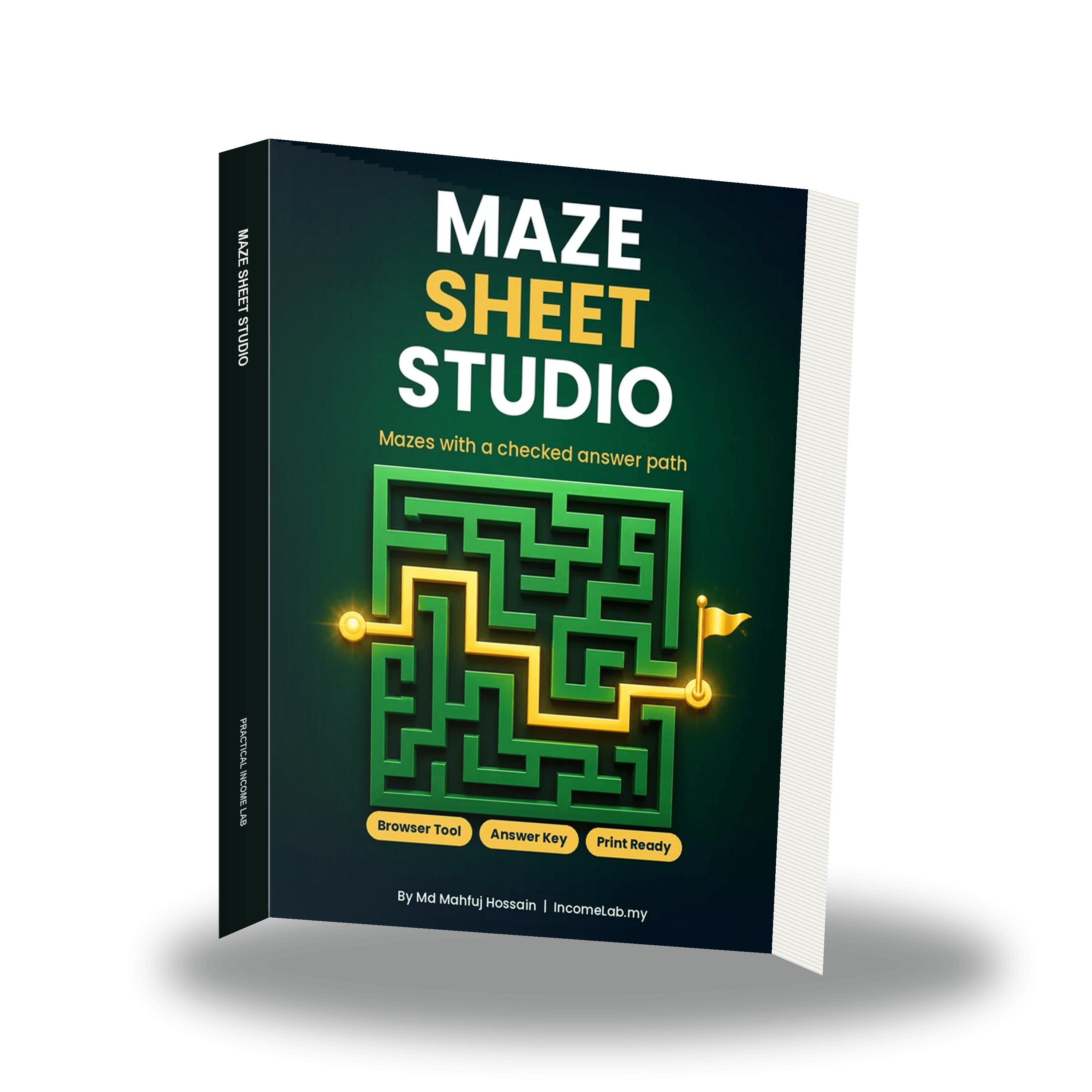
Maze Sheet Studio
Classical maze pages with a checked answer path, drawn in the browser
$27 on its own

Picture Clue Press
One kids' picture question with a single counted answer, before you draw the page
$19 on its own
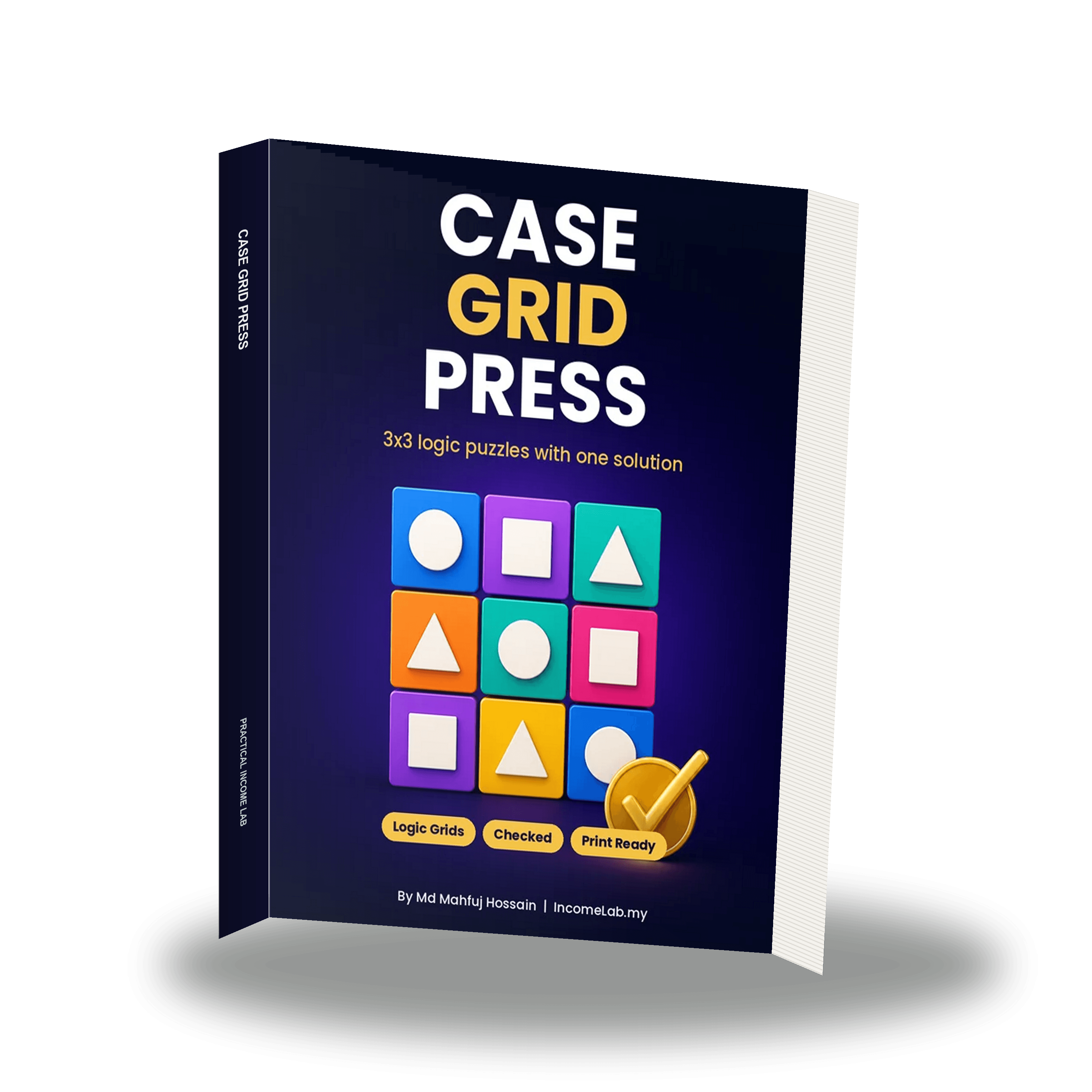
Case Grid Press
A three-by-three logic puzzle the tool has checked for a single solution
$27 on its own
Chapters
- 01Practical walkthrough and dated bundle note: PDF pages 1–8
- 02Maze Sheet Studio — current guide/corrections: PDF pages 9–17
- 03Picture Clue Press — current guide/corrections: PDF pages 18–29
- 04Case Grid Press — current guide/corrections: PDF pages 30–42
- 05Maze Sheet Studio — retained original section: PDF pages 46–134
- 06Picture Clue Press — retained original section: PDF pages 135–206
- 07Case Grid Press — retained original section: PDF pages 207–284
Read a free sample
No email needed. This is the book's real text, unedited.
Dated lab clarifications, 11 November 2026: use the current inserted title notes and revised companions before these retained extracts. Timings and score thresholds are planning aids, not proof or permission. Keep an unchanged baseline or no fault observed when accurate; do not invent interviews, drawbacks, faults or improvements. A fifteen-to-twenty-percent price rise is an optional scenario, not a rule. Do not force three exclusions or one-page terms at the expense of material information. Use synthetic or authorized source data; public availability is not unrestricted copying or AI-upload permission. Automation practice starts inactive and isolated; one week cannot establish four Friday observations. Record actual events and extend the schedule. An internal draft or held release can be the correct result.
Start here
The outcome
By day 14 you will have a finished maze booklet kit: twelve to twenty-four verified perfect mazes (each with one route and no loops), a matching answer key, print-ready SVG and PDF files with the seed recorded for every page, a page layout that respects the print rules you chose (Amazon KDP paperback or an Etsy-style printable), a licence statement you can paste into a listing, and a listing draft that says only what the files deliver. You also get a tested Python generator and checker, so the quality check does not depend on your eyes.
This is a process promise, not an income promise. Nothing here guarantees a sale, a ranking or a royalty. Every example number that is ours is invented for teaching and labelled HYPOTHETICAL EXAMPLE or FICTIONAL. Every outside fact (trim sizes, bleed, margins, AI-disclosure rules) is dated checked Nov 2026 and listed in the Sources chapter. Platform rules change, so check the current page before you upload.
Who this is NOT for
- Anyone hoping to upload a few hundred pages of unchecked output and wait. The book is about making fewer, verified pages.
- Anyone who needs coloured illustrations, story books or hand-drawn art. These are black-line maze pages.
- Anyone who wants legal advice about licensing or trademarks. The licence chapter gives the questions to ask, not a legal opinion.
Time needed
| What | Time |
|---|---|
| 30-minute quick start (Chapter 1) | 30 min |
| Theory and tiers (Chapters 2 to 6) | about 2 hours of reading, 2 hours of doing |
| The 20-page sample set and keys (Chapters 7 and 8) | 30 min to inspect |
| Layout, licence, quality, listing (Chapters 9 to 13) | 3 to 4 hours |
| 14-day plan (Chapter 14) | 45 to 90 minutes a day |
How to use this book
You can work with the free Maze Sheet Studio tool on the incomelab.my site or with the Python script in the template pack, or with both. The method is the same: pick a grid size, pick a seed, generate, verify, export a puzzle and an answer key, then lay out pages. The Python script (maze_gen.py) is included so you can run the checks yourself, and it uses its own seed generator, so a seed number in this book will not necessarily draw the same maze as the same number on the site. Always record which generator made a page along with the seed.
Each module has a concept, a hypothetical worked example, a timed exercise with a Done when box, a template, yes/no self-checks and an If you get stuck box. Model answers are in Chapter 16. Try first, check after.
Your route through the book
- Quick start: Chapter 1, 30 minutes
- Theory: Chapters 2 to 4
- Tiers and checks: Chapters 5 and 6
- Sample set: Chapters 7 and 8
- Publish: Chapters 9 to 13
- Ship: Chapters 14 and 15
Reading map
| If you are... | Read first | Then |
|---|---|---|
| A teacher making a class pack | Ch 1, Ch 5 tiers | Ch 8 keys, Ch 11 quality |
| A first-time KDP puzzle publisher | Ch 9 layout, Ch 12 licence | Ch 13 listing, Ch 14 plan |
| An Etsy printable seller | Ch 10, Ch 12 | Ch 13, Ch 14 |
| Curious about the maths | Ch 2, Ch 3 | Ch 6 verifying |
| Short of time | Ch 1, Ch 11, Ch 15 | The 14-day plan, compressed |
What is in the template pack
| File | What it is |
|---|---|
| maze_gen.py | Generator for five algorithms, verifier, SVG, PNG and PDF export (tested) |
| test_maze_gen.py | 121 checks including planted faults the verifier must catch |
| maze-01 to maze-20 (SVG, PNG) plus KEY versions | The 20 sample mazes, puzzle and answer key |
| maze-sample-set-20-puzzles.pdf, maze-sample-set-20-ANSWER-KEYS.pdf | Print-ready PDFs of the set |
| seed-register.csv | One row per maze: seed, grid, algorithm, measured metrics |
| maze-batch-planner.xlsx | Live formulas: page count, margin lookup, cell size, pass count |
| kdp-layout-calculator.xlsx | Trim size, bleed, margin and cell-size maths |
| maze-listing-and-licence.docx | Listing template and licence statement skeleton |
| EXAMPLE-FICTIONAL versions | Filled copies for an invented seller |
What you will do in 30 minutes
By the end of this chapter you will have made one maze, checked that it has exactly one route, produced its answer key, and saved a record of the seed. Everything else in the book repeats this loop at scale, so do it once now, even if you have made mazes before.
The 30-minute loop
- 0 to 5 min (Pick the size and seed): Choose 12 by 12 and seed 42. Write both on the register line below.
- 5 to 10 min (Generate): Open the free tool on the site, or run python3 maze_gen.py --size 12 --seed 42 --out out. You should see one opening on the top edge and one on the bottom edge.
- 10 to 18 min (Trace it): Put a finger on START and find FINISH by eye. Time yourself. This is your first difficulty reading.
- 18 to 24 min (Make the key): Export the same seed with the answer path shown. Compare the two files: the walls must be identical, only the red line differs.
- 24 to 30 min (Verify and record): Run the checker (or, with the web tool only, do the manual check in Chapter 6). Log the seed, grid, generator and the result.
Why start with a record
The most common failure in a maze booklet is not an ugly maze. It is a page you cannot reproduce. A buyer writes in with a question about page 17, you want to look at page 17, and you have a folder called final_final2. A seed in a register fixes that: the same generator and the same seed always draw the same maze, so the register is your memory.
Register line 1: your first maze
- Date:
- Generator used (site tool or maze_gen.py):
- Grid size:
- Seed:
- Algorithm (if known):
- Tracing time by eye:
- Verified one route? (yes / no / how checked):
Worked example (hypothetical)
Hypothetical example: Dina's first loop
Invented person "Dina", a primary-school teaching assistant. Not a real person; the numbers are made up to show the process.
Dina picks 8 by 8 because her class is seven years old. She uses seed 5, generates, and traces it in 40 seconds. She exports the key, lays the two files side by side, and sees the red line runs from the top opening to the bottom opening without crossing a wall. She logs seed 5, 8x8, the generator and "traced and key matches". That is a complete loop. It took her 22 minutes because she stopped to read the tool's size options.
Exercise 1.1 (30 minutes): run the loop
Do the five steps above with 12 by 12 and seed 42, or your own pair. Fill register line 1. Then answer: how long did your finger trace take, and does the red answer line pass through any cell twice?
Done when
You hold two files with the same seed (puzzle and key), the walls match, the register line is complete, and you know your tracing time.
Self-check
- Do the puzzle file and key file have the same walls? yes / no
- Is the seed written down somewhere other than the filename? yes / no
- Does the answer line enter the grid at the top opening and leave at the bottom opening? yes / no
- Did you note which generator made the file? yes / no
The files do not match
If the key shows a different maze, you changed the seed or the size between exports. Return to the same two numbers and export again. Never fix a mismatch by editing walls in a drawing program: that breaks the guarantee that the maze has one route.
Version 2.0-r20261109 · changelog
- 2.0 (2 November 2026): Rebuilt from the v2.0 guides: the desk PDF now contains the three rebuilt titles in full (242 pages, about 66,400 words) with a start-here page, plus a combined 211-file template folder. Removed the line about free companion tools, which is not part of the download.
- 1.0: Desk edition. Prices of the included books are listed on their own pages. 9 November 2026: revised practical walkthrough, editorial corrections and checked local deliverables. 11 November 2026: original compiled PDF retained with current included-title correction appendices; bundled companions synchronized to individual downloads, a matching templates ZIP added and current reading map/file hashes supplied. Schedules, score gates and old file/page-count claims corrected.
Pairs well with
- Planned · $27
Printables
36/40Maze Sheet Studio
Classical maze pages with a checked answer path, drawn in the browser
See what's inside4.9(34) - Planned · $19
Children's Printables
36/40Picture Clue Press
One kids' picture question with a single counted answer, before you draw the page
See what's inside4.8(26) - Planned · $27
Puzzle Books
36/40Case Grid Press
A three-by-three logic puzzle the tool has checked for a single solution
See what's inside4.9(32)